3.5% Rule’: The Anti-Trump Movement Is Nearing an Important Threshold

MSNBC by The Rachel Maddow

An excerpt from The Rachel Maddow Show highlights how the recent No Kings rallies signal a new stage of organized, nonviolent resistance. Seven million people took part nationwide — one of the largest single-day protest turnouts in U.S. history — as thousands of local events replaced the old model of single-city marches. Drawing on new research from Harvard’s Kennedy School, Maddow connects this decentralized momentum to political scientist Erica Chenoweth’s “3.5 percent rule,” which shows that when roughly 3.5 percent of a population engages in sustained, peaceful protest, movements almost always prevail. With participation expanding into traditionally pro-Trump counties, the data suggest that the U.S. is edging closer to that historic threshold where disciplined, nonviolent action can deliver real change.

Read the full article at MSNBC

Why Nonviolent Protest Can Work When We Actually Try It

Nick Allison challenges the fatalism that says peaceful protest has “already been tried.” Drawing on data from Erica Chenoweth and Maria Stephan, he argues that disciplined nonviolent movements succeed far more often than violent uprisings—and that no campaign reaching even 3.5 percent of a population’s active participation has ever failed. From Gandhi to King to Havel, history shows the power of organized nonviolence, and Allison contends Americans have yet to test it at scale. His call isn’t for revolution but for civic discipline: fill the streets, stay peaceful, and defend democracy without surrendering the moral high ground. Violence, he warns, only feeds authoritarianism; sustained, visible nonviolence erodes it.

Read the full essay at The Fulcrum.

No Kings: National Day of Action, October 18


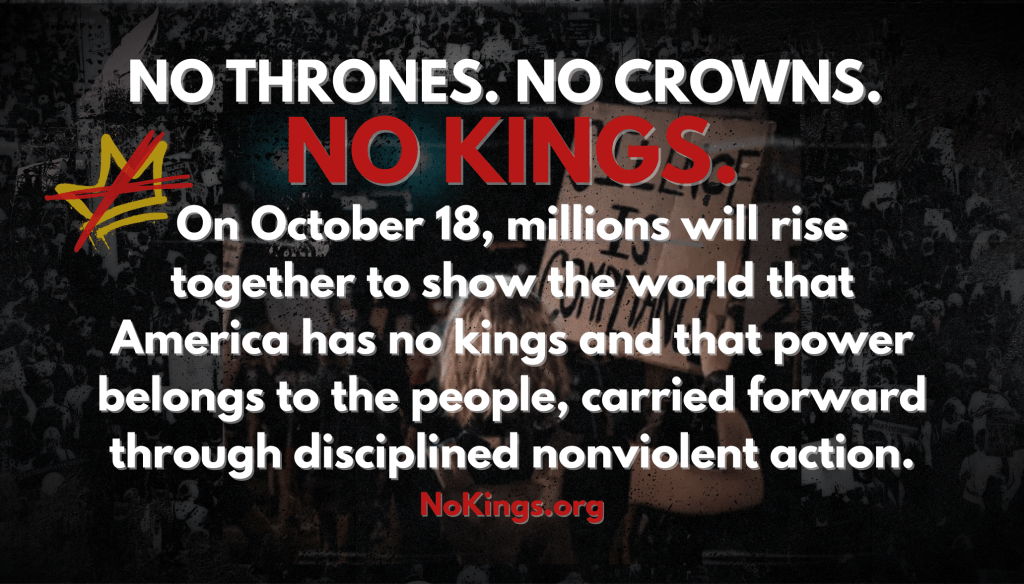
On October 18, the No Kings coalition is organizing a National Day of Action with one clear message: America has no kings, and power belongs to the people. Their call is rooted in disciplined nonviolence — organizers stress de-escalation, lawful action, and a strict ban on weapons at events. Trainings on protest safety and “know your rights” are underway, equipping participants to resist authoritarian drift without feeding cycles of violence.

→ Read more at No Kings

The Future of Nonviolent Resistance


Journal of Democracy, 2020 — by Erica Chenoweth

Nonviolent civil resistance has become the most common way people challenge regimes, peaking in 2019 with mass uprisings across dozens of countries. Yet success rates dipped in the 2010s. Chenoweth argues the decline isn’t only because states got savvier; movements also changed: peak participation has been smaller, campaigns over-rely on big marches (and underuse disruptive tactics like general strikes), digital organizing boosts turnout but weakens long-term structure and makes surveillance easier, and violent “flanks” sap legitimacy. Even so, nonviolent campaigns still outperform violent ones by a wide margin because broad numbers drive disruption and elite defections. The pandemic briefly paused street protests but pushed organizers toward relationship-building, strategy, mutual aid, and diversified tactics—ingredients that make movements more durable. Takeaway: disciplined nonviolence, large and diverse participation, and sustained organizing are what bend outcomes, including against authoritarian drift.

Read the article → Journal of Democracy

5 Peaceful Protests That Led to Social and Political Changes

Global Citizen, July 8, 2016 — by Meghan Werft and Julie Ngalle

From Gandhi’s Salt March to Rosa Parks’ refusal to give up her seat, history shows how nonviolent action can spark profound political and social change. This piece highlights five landmark movements—the Salt March, the 1913 Suffrage Parade, the Delano Grape Boycott, the Montgomery Bus Boycott, and Estonia’s Singing Revolution—each proving that peaceful resistance can topple unjust systems, expand civil rights, and even win independence. Together, they serve as powerful reminders that sustained, nonviolent protest can achieve what violence cannot: lasting systemic change.

→ Read the full story at Global Citizen